


Data product as a measurable business asset
Value-driven cost management in a data mesh environment.



Introduction
FinOps (Financial Operations) within strategic data initiatives ensures transparent cost management and value optimization, ensuring that investments in data products directly contribute to business objectives and ROI. As companies embrace data mesh to decentralize data ownership, FinOps becomes essential not only for managing cloud costs but also for gaining insight into the strategic and financial value of data products.
Modern platforms like Snowflake provide powerful support for this with capabilities such as tagging, metadata analysis, and cost monitoring. By treating data as a product and leveraging such tools, organizations with a sound FinOps framework can not only measure costs per domain or workload but, by making value measurable, also gain insight into which data products actually add value to the business.
In this blog, we explore the challenges and strategies of FinOps within a decentralized data mesh architecture and how Snowflake can be used to make cost allocation per data product and the quantification of strategic value concrete and scalable.
FinOps and data products as strategic assets
Data products should be treated as full-fledged strategic assets, similar to software products. Just like in software development, data products have cost components such as development, maintenance, and operational costs, but they also possess a potential strategic value. The latter can range from better decision-making and process optimization to new revenue streams, improved customer experience, and AI-driven innovation.
An effective FinOps model goes beyond mere cost control: it helps companies gain insight into the business impact and strategic value of their data products. This means that not only must cloud and infrastructure costs be allocated and managed, but, more importantly, the relationship between investment and return must be mapped out.
Strategic Investments in Data Products
Companies invest in FinOps within a data mesh architecture to optimize costs while simultaneously realizing strategic value. Some key areas in which companies invest:
- Financial value: cost optimization and new revenue models through data sharing and subscription-based data services.
- Operational efficiency: smarter decisions and process optimization with AI and automation.
- Customer value and market position: real-time customer analytics and personalized marketing.
- Risk management and compliance: governance and security measures for data privacy and regulations.
- Innovation and growth: AI, machine learning, and external data integrations to discover new market opportunities.
A well-implemented FinOps framework ensures that these investments are made measurable and actionable, allowing organizations to purposefully allocate resources to data products that truly contribute to business objectives and innovation.
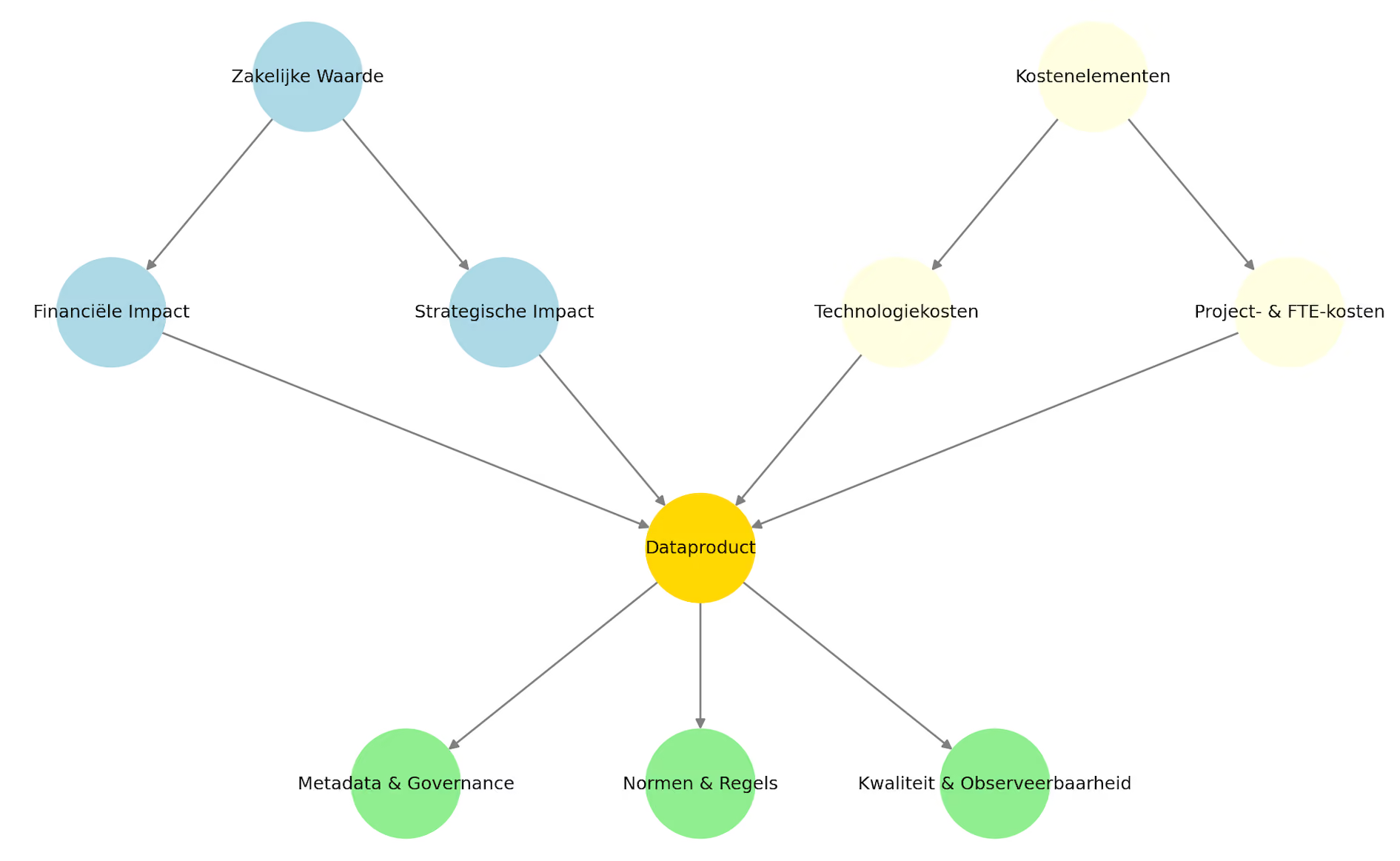
This diagram shows how a data product connects to multiple domains, including business value (such as financial and strategic impact), cost elements (such as technology and personnel costs), and governance aspects (such as metadata, standards, and quality). It underscores the multidimensional approach required to effectively assess and manage data products.
Gaining insight into the costs and value of data products
One of the core principles of FinOps in a data mesh environment is the transparent allocation of costs to specific data products and the measurement of the value they deliver. In practice, however, the costs of a data product are spread across multiple technologies and processes, such as data pipelines, ETL tools, cloud storage, compute resources, and API costs. This makes it complex to get a clear picture of the actual investments and operational (OPEX) costs per data product and how these relate to the generated value.
An effective FinOps model therefore requires a broad and structured approach that not only provides insight into consumption within a specific data platform but also takes into account supporting technologies and processes. Through careful cost allocation and monitoring, organizations can gain a holistic view of the total costs and strategic value of their data products, which helps in data-driven investment decisions and optimization.
Successfully applying FinOps principles within a data mesh requires not only organizational alignment, but technological support as well. This is where modern data platforms like Snowflake come into play: they provide the necessary tools, such as detailed metadata, usage metrics, and query tagging, to analyze and manage the cost, efficiency, and value of data products in a structured way.
These mechanisms make it possible to better identify and analyze components of data products within the platform. In this blog, we discuss some concrete implementations in Snowflake to effectively gain insight into the costs and value of data products.
Object tagging for cost management and strategic value
- Use tags to allocate costs to specific data products and teams.
- Combine this cost information with business metrics to measure the impact and ROI of data products.
- Example:
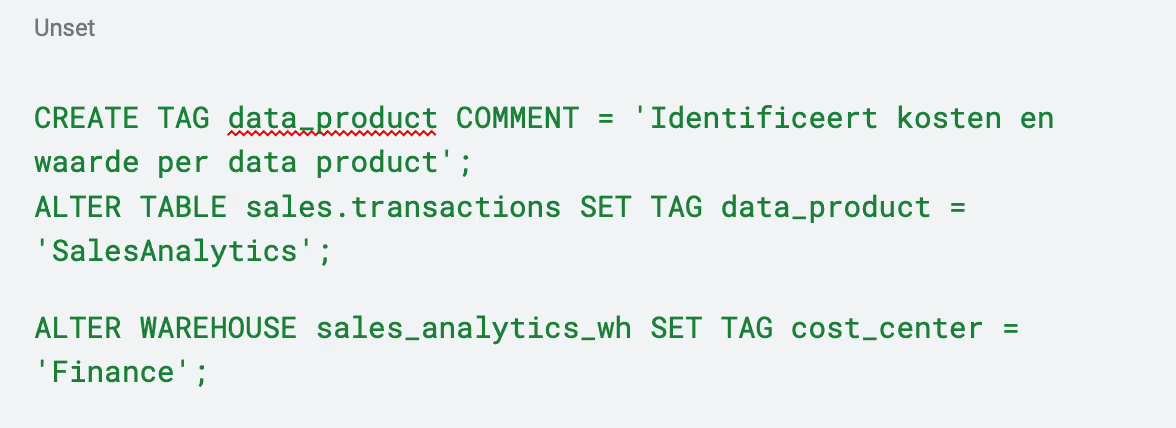
- By combining tagging with ACCOUNT_USAGE views – which make usage and cost information available per object – not only can budget monitoring and reporting be automated, but value indicators can also be analyzed.
Structuring database and warehouse objects for valuation
To determine the strategic value of data products, costs and performance must be analyzed in relation to business KPIs:
- Data product tagging: use separate databases or schemas per data product to better isolate ownership and costs.
- Cost Center tagging: share warehouse resources between teams, while tagging warehouses and credit consumption helps identify specific costs by allocating them to data product objects and development stages at the query level.
- Defining and linking value: connect usage metrics to business impact, for example by measuring the number of decisions based on a data product.
- Defining budgets and comparing them with consumption per data product. This helps control costs, prevent budget overruns, and set up active notifications for when budgets are exceeded.
Interactive value analysis with a custom Streamlit application and active notifications via budgets
A custom Streamlit application can help organizations gain insight into development and management costs. By building a dashboard that analyzes Snowflake metadata and query logs, companies can understand how data products are used and the costs they generate. Assigning value to each data product then makes the cost-to-value ratio clear.
Example Snowflake FinOps implementation
Identifying costs per data product → Extracting Snowflake metadata by using object tagging and query logs and relating them to one another.
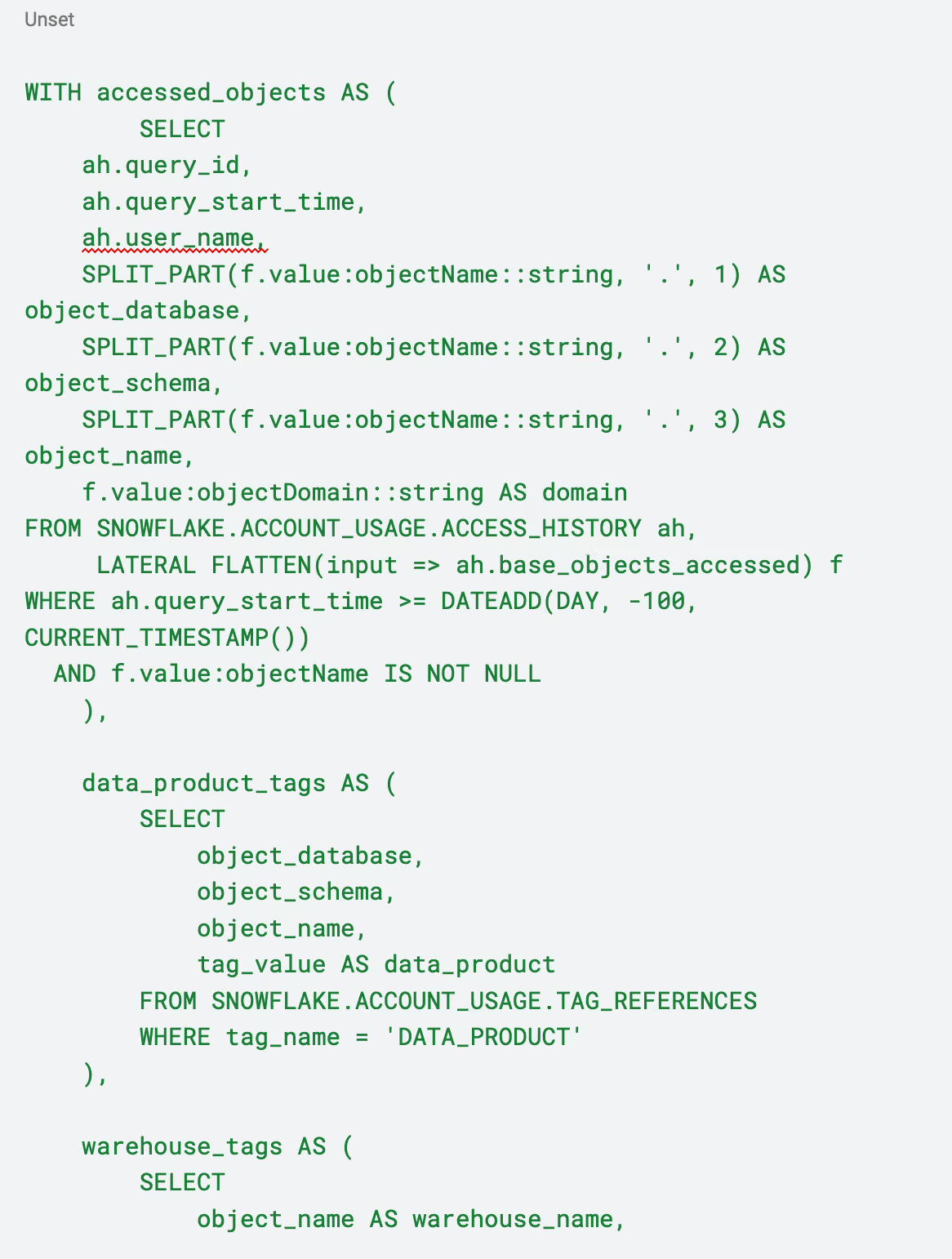
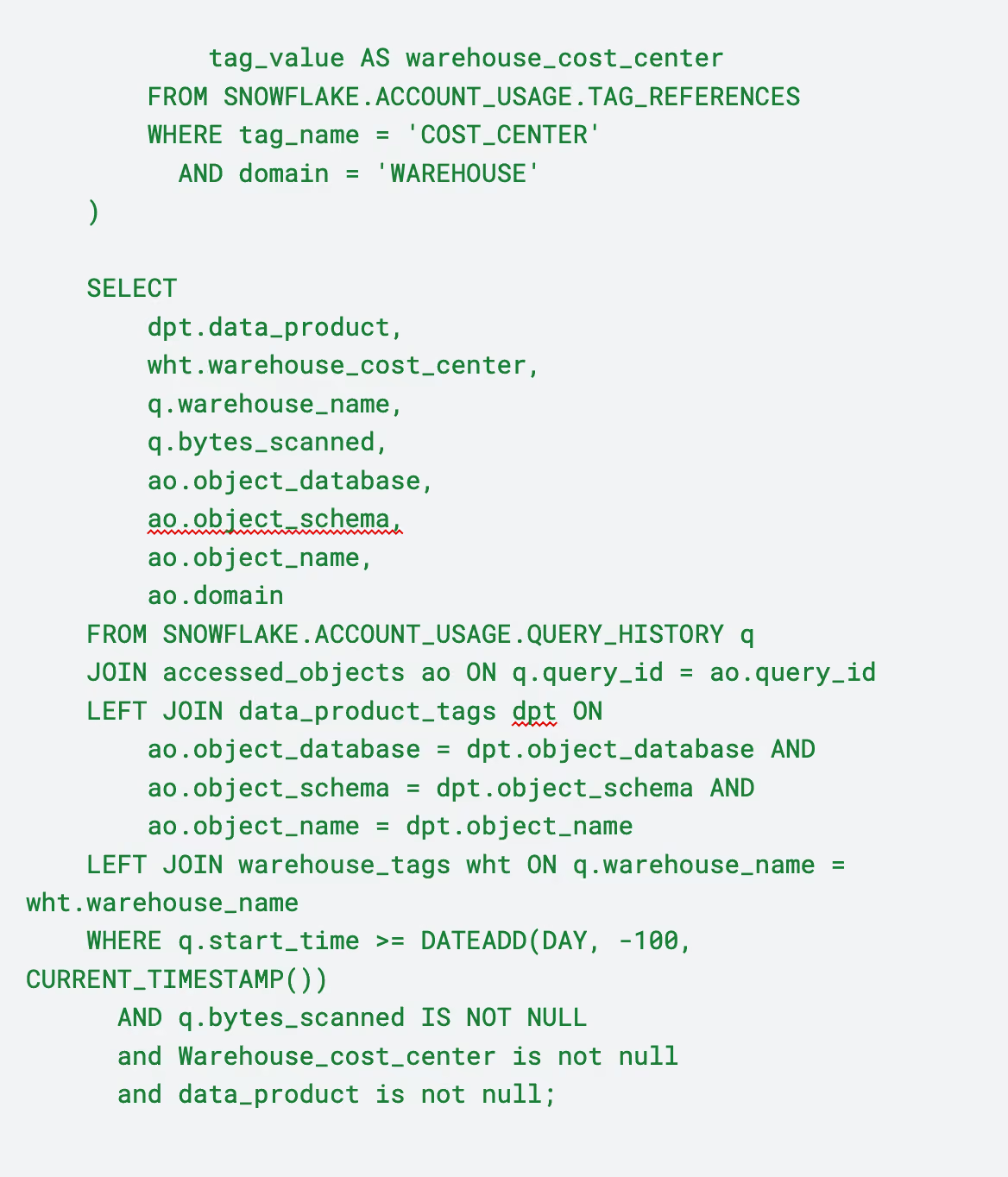
Building real-time dashboards → Use Streamlit to display interactive charts and tables and link them to business KPIs to gain strategic insights.
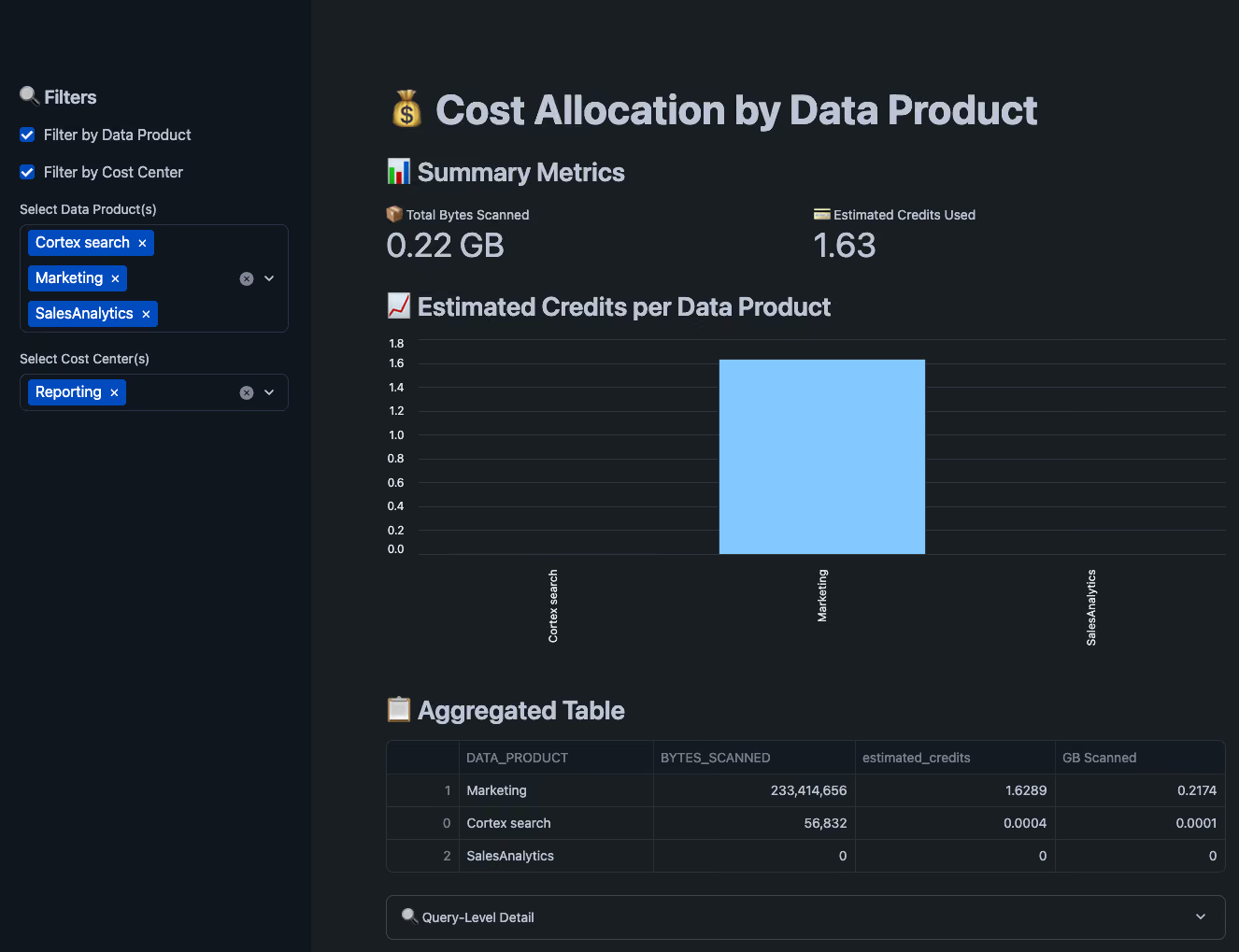
With this approach, organizations can not only accurately allocate costs per data product but also proactively optimize where necessary and make strategic decisions regarding their data investments.
Conclusion
A data mesh environment requires a FinOps approach that goes beyond cost management: it is about determining the value of data products. By leveraging Snowflake’s monitoring, tagging, and optimization features, organizations can make costs transparent and make strategic decisions about data product investments.
This blog post was previously published on navara.nl
Featured posts
We don't do off-the-shelf job openings. We create your ultimate role based on your personal ambitions and expertise.